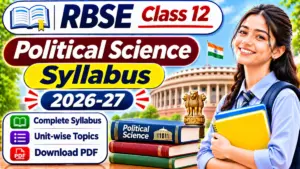
Political Science (Subject Code 11) carries a total of 100 marks, including 80 marks for the written examination and 20 marks for sessional assessment. The theory examination lasts 3 hours and 15 minutes. Students can check the chapter-wise syllabus, marks distribution and PDF download details below.
Direct Link to RBSE Class 12 Political Science Syllabus 2026-27 PDF
RBSE Class 12 Political Science Syllabus 2026-27 – Overview
| Board Name | Board of Secondary Education, Rajasthan (RBSE) |
| Examination | RBSE Class 12 Board Examination 2027 |
| Academic Session | 2026-27 |
| Class | 12th |
| Stream | Arts |
| Subject | Political Science |
| Subject Code | 11 |
| Official Website | rajeduboard.rajasthan.gov.in |
RBSE Class 12 Political Science Syllabus 2026-27 PDF Download
The Rajasthan Board provides the Class 12 syllabus for the 2026-27 academic session through its official website. The Political Science syllabus contains the prescribed chapters, topics and marks distribution for the 2027 board examination.
Official Syllabus PDF: Direct Link to RBSE Class 12 Political Science Syllabus 2026-27 PDF
The official Class 12 syllabus PDF contains multiple subjects. Students should locate Political Science (Subject Code 11) in the document.
RBSE Class 12 Political Science Exam Pattern 2026-27
The RBSE Class 12 Political Science examination carries 100 marks. The written examination accounts for 80 marks, while the remaining 20 marks are allotted to sessional assessment. The theory syllabus is divided equally between two parts.
| Examination Component | Marks |
|---|---|
| Part A: Contemporary World Politics | 40 |
| Part B: Politics in India Since Independence | 40 |
| Total Theory Marks | 80 |
| Sessional/Internal Assessment | 20 |
| Grand Total | 100 |
Both parts carry equal weightage in the theory examination. However, individual chapters are assigned different marks, so students should prepare according to the prescribed chapter-wise distribution.
RBSE Class 12 Political Science Chapter-Wise Marks Distribution 2026-27
The syllabus includes seven chapters in Contemporary World Politics and eight chapters in Politics in India Since Independence.
Part A: Contemporary World Politics – 40 Marks
| Chapter | Chapter Name | Marks |
|---|---|---|
| 1 | The End of Bipolarity | 6 |
| 2 | Contemporary Centres of Power | 6 |
| 3 | Contemporary South Asia | 6 |
| 4 | International Organisations | 6 |
| 5 | Security in the Contemporary World | 6 |
| 6 | Environment and Natural Resources | 6 |
| 7 | Globalisation | 4 |
| Total | Part A | 40 |
Part B: Politics in India Since Independence – 40 Marks
| Chapter | Chapter Name | Marks |
|---|---|---|
| 1 | Challenges of Nation Building | 6 |
| 2 | Era of One-Party Dominance | 4 |
| 3 | Politics of Planned Development | 2 |
| 4 | India’s External Relations | 6 |
| 5 | Challenges to and Restoration of the Congress System | 4 |
| 6 | The Crisis of the Democratic Order | 4 |
| 7 | Regional Aspirations | 6 |
| 8 | Recent Developments in Indian Politics | 8 |
| Total | Part B | 40 |
Part A: Contemporary World Politics Syllabus
Part A covers important political developments across the world, including the end of the Cold War, the emergence of new centres of power, international organisations, security challenges and globalisation.
Chapter 1: The End of Bipolarity (6 Marks)
This chapter explains the Soviet political system, the dissolution of the Soviet Union and its effects on international relations.
- The Soviet System
- Mikhail Gorbachev and the disintegration of the Soviet Union
- Causes and consequences of the Soviet Union’s disintegration
- Shock Therapy in post-communist countries and its consequences
- Tensions and conflicts following the Cold War
- India’s relations with post-communist countries and the USSR
Chapter 2: Contemporary Centres of Power (6 Marks)
This chapter discusses the emergence of major economic and political powers after the Cold War and their influence on international relations.
- European Union
- Association of Southeast Asian Nations (ASEAN)
- Rise of the Chinese economy
- India-China relations
- Japan and South Korea as centres of power
Chapter 3: Contemporary South Asia (6 Marks)
Students study the political developments of South Asian countries and the challenges involved in maintaining peace and cooperation within the region.
- Political developments in South Asia
- Military rule and democracy in Pakistan
- Democracy in Bangladesh
- Monarchy and democracy in Nepal
- Ethnic conflict and democracy in Sri Lanka
- India-Pakistan conflicts
- India’s relations with neighbouring countries
- Regional peace and cooperation
Chapter 4: International Organisations (6 Marks)
This chapter explains why international organisations are necessary and examines their structure, functions and role in resolving global problems.
- Importance of international organisations
- Evolution of the United Nations
- Reforms of the UN after the Cold War
- Reforms in UN structures, processes and jurisdiction
- India and UN reforms
- United Nations in a unipolar world
- International Monetary Fund, World Bank and WTO
- International Atomic Energy Agency
- Amnesty International and Human Rights Watch
Chapter 5: Security in the Contemporary World (6 Marks)
This chapter examines traditional and non-traditional security concerns and explains how nations respond to different threats.
- Meaning and concept of security
- Traditional notions of external and internal security
- Traditional security and international cooperation
- Non-traditional notions of security
- Cooperative security
- New sources of threats
- Human rights
- India’s security strategy
Chapter 6: Environment and Natural Resources (6 Marks)
Students learn about global environmental challenges, resource management and the relationship between politics and environmental protection.
- Environmental concerns in global politics
- Protection of global commons
- Common but Differentiated Responsibilities
- Common property resources
- India’s position on environmental issues
- Environmental movements
- Resource geopolitics
- Indigenous peoples and their rights
- Sacred groves in India
- Antarctica and global environmental governance
Chapter 7: Globalisation (4 Marks)
This chapter covers the meaning, causes and consequences of globalisation, particularly its impact on political, economic and cultural life.
- Concept and causes of globalisation
- Political consequences of globalisation
- Economic consequences of globalisation
- Cultural consequences of globalisation
- India and globalisation
- Resistance to globalisation
- India and resistance to globalisation
Part B: Politics in India Since Independence Syllabus
Part B focuses on India’s political development since Independence. It includes nation-building, electoral politics, economic planning, foreign policy, the Emergency, regional movements and recent political developments.
Chapter 1: Challenges of Nation Building (6 Marks)
This chapter examines the major challenges faced by India after Independence and the measures adopted to establish national unity and democratic governance.
- Challenges facing the newly independent nation
- Three major challenges of nation-building
- Partition, displacement and rehabilitation
- Process and consequences of Partition
- Mahatma Gandhi’s sacrifice
- Integration of princely states
- Hyderabad and Manipur
- Government’s approach to national integration
- Reorganisation of states
- Creation of new states
Chapter 2: Era of One-Party Dominance (4 Marks)
This chapter explains the dominance of the Indian National Congress in the early general elections and the development of opposition politics.
- Challenge of building democracy
- Congress dominance in the first three general elections
- Nature of Congress dominance
- Emergence of opposition parties
- Socialist Party
- Communist Party of India
- Bharatiya Jana Sangh
- Changing voting patterns
Chapter 3: Politics of Planned Development (2 Marks)
This chapter discusses India’s approach to economic development after Independence and the political debates surrounding planning.
- Political contestation and conflicts
- Different ideas of development
- Economic planning and early initiatives
- First Five-Year Plan
- Rapid industrialisation
- Decentralised planning
- Planning Commission
- NITI Aayog
Chapter 4: India’s External Relations (6 Marks)
This chapter examines the principles of Indian foreign policy and India’s relations with major countries and neighbouring nations after Independence.
- International context after Independence
- Policy of Non-Alignment
- Jawaharlal Nehru’s role in foreign policy
- Maintaining distance from rival power blocs
- Afro-Asian unity
- India-China relations and the 1962 conflict
- Tibet issue
- India-Pakistan wars and peace efforts
- Bangladesh War of 1971
- Kargil confrontation
- India’s nuclear policy and nuclear programme
- Changing equations of world politics
Chapter 5: Challenges to and Restoration of the Congress System (4 Marks)
This chapter explains the political challenges faced by the Congress party during the late 1960s and early 1970s, including electoral changes and internal divisions.
- Challenge of political succession
- Fourth General Election of 1967
- Electoral verdict and non-Congressism
- Coalition governments
- Defection in Indian politics
- Split in the Congress party
- Indira Gandhi and the Syndicate
- Presidential Election of 1969
- General Election of 1971 and restoration of Congress dominance
- Abolition of Privy Purses
Chapter 6: The Crisis of the Democratic Order (4 Marks)
This chapter covers the circumstances leading to the Emergency in India, its consequences and the political developments that followed.
- Background to the Emergency
- Gujarat and Bihar movements
- Conflict between the government and judiciary
- Declaration of Emergency
- Lessons of the Emergency
- Politics after the Emergency
- Lok Sabha Election of 1977
- Janata Government
Chapter 7: Regional Aspirations (6 Marks)
Students examine the political aspirations of different regions and how India has addressed demands for autonomy, identity and national integration.
- Relationship between region and nation
- Indian approach to regional aspirations
- Areas of regional tension
- Jammu and Kashmir
- External and internal disputes
- Political developments in Punjab
- Cycle of violence and efforts toward peace
- Autonomy demands in Northeast India
- Secessionist movements
- Movements against outsiders
- Accommodation and national integration
- Sikkim’s merger with India
- Goa’s liberation
- Dravidian movement
Chapter 8: Recent Developments in Indian Politics (8 Marks)
This chapter carries the highest individual chapter weightage in the Political Science theory syllabus. It examines major political changes since the 1990s, including coalition governments, caste-based mobilisation and changing party politics.
- Political developments of the 1990s
- Era of coalition governments
- Decline of Congress dominance
- Alliance politics
- Political rise of Other Backward Classes
- Mandal Commission and its political consequences
- Communalism and secularism
- Democracy and changing political debates
- Ayodhya dispute and subsequent developments
- Emergence of a new political consensus
RBSE Class 12 Political Science Important Chapters 2026-27
The highest-weightage chapter is Recent Developments in Indian Politics, carrying 8 marks. Several other chapters carry 6 marks each. Students can use this distribution to allocate revision time without leaving out the lower-weightage chapters.
| Chapter | Marks |
|---|---|
| Recent Developments in Indian Politics | 8 |
| The End of Bipolarity | 6 |
| Contemporary Centres of Power | 6 |
| Contemporary South Asia | 6 |
| International Organisations | 6 |
| Security in the Contemporary World | 6 |
| Environment and Natural Resources | 6 |
| Challenges of Nation Building | 6 |
| India’s External Relations | 6 |
| Regional Aspirations | 6 |
RBSE Class 12 Political Science Question Paper Pattern 2027
The theory examination is worth 80 marks and lasts 3 hours and 15 minutes. According to the supplied syllabus guide, students should prepare for different question formats, including objective and descriptive questions.
- Multiple-choice questions
- Very short-answer questions
- Short-answer questions
- Long-answer questions
- Descriptive questions
The exact number of questions, section-wise marks and internal choices should be checked against the official model question paper issued for the 2027 examination.
How to Download RBSE Class 12 Political Science Syllabus 2026-27 PDF?
Students can download the Rajasthan Board Class 12 Political Science syllabus by following these steps:
- Visit the official Rajasthan Board website at rajeduboard.rajasthan.gov.in.
- Open the syllabus section.
- Select the syllabus for examination year 2027.
- Choose the Class 12 syllabus PDF.
- Find Political Science (Subject Code 11) in the document.
- Review the chapter-wise topics and marks distribution.
- Download and save the PDF for reference.
How to Prepare for RBSE Class 12 Political Science Exam 2027?
Students should plan their preparation according to the prescribed chapters and chapter-wise weightage. Both parts of the syllabus carry 40 marks, making balanced preparation important.
- Complete all 15 prescribed chapters.
- Prepare separate notes for Contemporary World Politics and Politics in India Since Independence.
- Allocate additional revision time to the 8-mark and 6-mark chapters.
- Understand important political events, constitutional developments and international relations.
- Prepare timelines for major historical and political events.
- Practise short-answer and long-answer questions.
- Solve available RBSE previous-year question papers.
- Use the latest official model paper to practise examination-style questions.
- Revise both parts regularly before the examination.
RBSE Class 12 Political Science Syllabus 2026-27 – Important Links
Have a Question About This Job?
Ask doubts, report errors and get helpful replies.
Q1. Is the RBSE Class 12 Political Science Syllabus 2026-27 available?
Yes. The Rajasthan Board has listed the Class 12 syllabus for examination year 2027 on its official website. Students can access the syllabus PDF and check the prescribed Political Science chapters and marks distribution.
Q2. How many chapters are included in RBSE Class 12 Political Science?
The RBSE Class 12 Political Science syllabus includes 15 chapters. Part A, Contemporary World Politics, contains seven chapters, while Part B, Politics in India Since Independence, contains eight chapters.
Q3. What is the RBSE Class 12 Political Science exam pattern for 2027?
The examination carries 100 marks, including 80 marks for the written theory paper and 20 marks for sessional assessment. The theory paper has a duration of 3 hours and 15 minutes.
Q4. What is the subject code for RBSE Class 12 Political Science?
The subject code for Political Science in the Rajasthan Board Class 12 syllabus is 11.
Q5. Which chapter has the highest weightage in RBSE Political Science?
Recent Developments in Indian Politics carries the highest individual chapter weightage of 8 marks. Several other chapters carry 6 marks each, including India’s External Relations and Regional Aspirations.
About the Author
Mahalakshmi is an education content specialist with 6+ months of experience in creating education-related articles. She has published informative content covering famous universities, admission updates, courses, academic opportunities, and student-focused career guidance for learners seeking reliable education information. With a Bachelor’s degree in Computer Science from Bharathiar University, Mahalakshmi combines research skills with clear, user-focused writing to provide accurate and helpful content that supports students in making informed academic decisions.
Other Posts You Might Be Interested In
-
KV Picket Secunderabad Half Yearly Time Table 2026-27 Out – Check Class 11 Exam Dates @ picket.kvs.ac.in
1 hour ago
Mahalakshmi Karunakaran -
DSPMU UG Result 2026 Out – Direct Link to Check Result Online @ dspmuranchi.ac.in
1 hour ago
Mahalakshmi Karunakaran -
BTEUP Odd Semester Admit Card 2026 Out – Download Hall Ticket @ bteup.ac.in
2 hours ago
Dheshni Rani -
VBSPU Odd Semester Time Table 2026-27 Out – Download UG & PG Exam Schedule @ vbspu.ac.in
2 hours ago
Dheshni Rani -
HPU Revised Date Sheet 2026 Out – Download PDF Online at hpuniv.ac.in
2 hours ago
Dheshni Rani